
Symphony for Baton and Soap Box
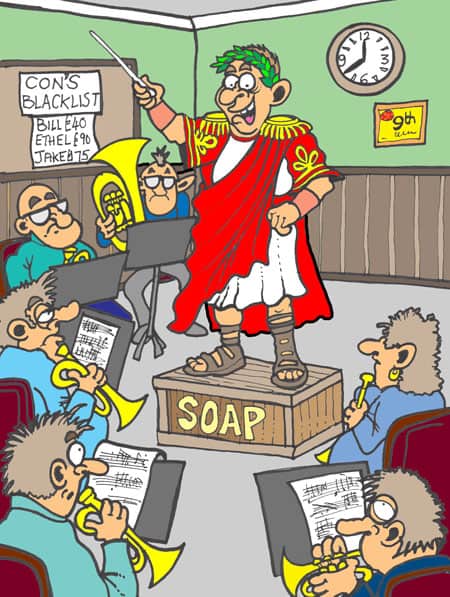
You look forward to those two hours of intense playing, getting really stuck into a test piece for the contest. You’re whistling the tuneful parts all the way to the band room, with a smile plastered over your face. Parts practised at home – ready, pumped and stoked. Every seat is filled; everyone is there.
The anticipation’s building as the clock ticks towards the start of rehearsal. The band room buzzes with energy, a tangible electrical force coursing through every stand, mute and timp’ stick.
The conductor looks at the clock, raises the baton.
Everyone takes a breath.
Then he puts the baton back on the stand and sticks a pin in the balloon that was filled with all those charged emotions.
“Before we look at the test piece tonight, I’d just like to talk you through the score…”
Groans and shuffling seats. Phones are taken out to fill in the time – especially as United are playing City.
“The composer had nuances that need to be brought out…”
Three players excuse themselves for a toilet break – actually going outside for a ciggy.
“Although the arranger indicated this tempo, it’s my opinion that it’s not what the composer intended in 1825…”
Someone in the horn section begins to snore.
“And it’s important to remember what the original orchestral version was trying to portray…”
Several whispered conversations begin on the back-row cornets.
“And even though it isn’t in the score, I am going to make significant changes to the attack of each note to honour what I believe was the composer’s intention…”
The bass section begin sending texts.
“The last six bars are marked on your parts as an accelerando, but I’m changing this to a massive rallentando, to give an air of mystique, standing out from the other bands…”
Several players begin to snigger.
“And I want the entire band to stand and face out from letter B to the end to project the sound…”
More laughter and several curses.
After a forty-five minute monologue, the conductor lifts the baton, taps the stand and counts the band in. Half the band aren’t ready; some need waking, some need to put their phones away, and the tuning – after three-quarters of an hour of being stone cold – suffers.
Out comes the tuning device.
Another fifteen minutes are spent pulling slides in and out and, when that’s done, the hatch opens, and Doris rattles a small bell for the tea break.
Sound familiar?
Maybe I’ve exaggerated by five minutes, but there are those conductors who love the sound of their own voice. Orators from another world. The planet of I, Me and Myself. They often talk in a monotone, predictable, uninteresting, boring and downright mind-sapping voice – a thrilling tribute to the concept of almost conscious.
We go to band to improve our music as a team, not to listen to a droning lecture.
The worst of the Ambassadors of the Republic of Clock Vandalism are the ones who repeat the same directions.
“The first three notes at letter G need to be very short… like this,” they say, tapping the stand three times.
Not content, they go on.
“The first three notes at letter G should be staccato, each one much shorter than any other note in that section – sharp and concise. Three stand-out notes for their shortness. So short they can be heard in the echoing hall. As short as you can play them.”
He raises the baton, then stops.
“Remember… short notes.”
Do they ever stop and think we might just get it the first time?
And another thing… conductors who go off at a tangent.
“Trombones, let’s try the tricky section…”
The rest of the band fidget and start talking, texting and watching the second half of United v City, while Lord of the Misguided goes over and over and over a two-bar section with the trombones for twenty minutes.
Time that should have been put aside for a sectional rehearsal – or a very quick flea in the ear to each trombonist to actually do some home practice.
End of rant!
Don’t you just love conductors who have all the time in everybody else’s world!