
Hydration Before Interpretation
Hydration Before Interpretation
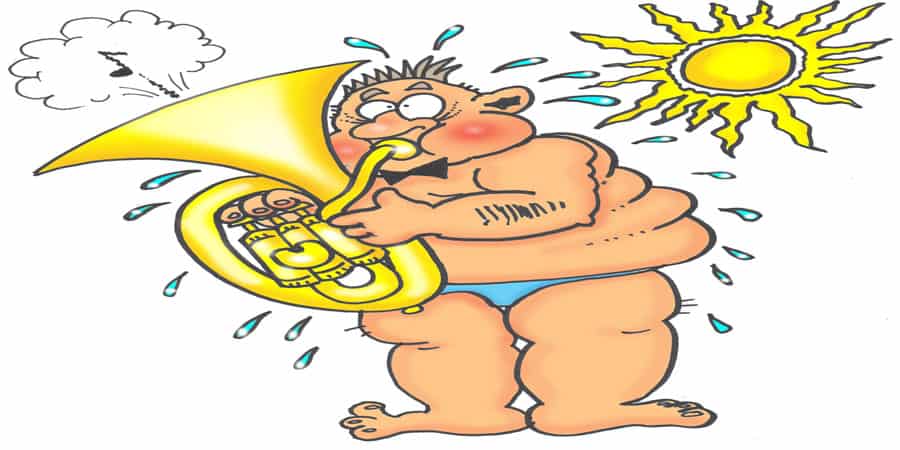
I must admit that, until recently, I hadn’t given much thought to the effect climate change might have on brass bands. Rising sea levels, melting glaciers and extreme weather all seemed rather remote from the average evening rehearsal in a draughty church hall somewhere in the British Isles.
Then it struck me. If climate change can affect polar bears, vineyards and migrating swallows, surely it won’t be long before it starts interfering with baritones. We’ve already begun to notice the warning signs.
There have been two temperature settings this summer in our bandroom at Tongwynlais Temperance… melt and frostbite. The bandroom is fitted with air-con and, when it’s not switched on, even your eyeballs sweat. When it’s on full blast, it’s absolutely Baltic and I swear I saw a penguin in the percussion section last week. Our poor flugel horn player, who sits directly in the icy blast, regularly turns a nasty shade of Willow Pattern blue, with teeth chattering like castanets. It’s like a holiday in the UK – you never know quite what to wear to the bandroom.
Donald Trump, in one of his never-ending Hans Christian Andersen moments, dismissed climate change as a hoax. “It will get cooler,” he said. What he didn’t say was when! Until this unfathomable theory comes to fruition, we have to adapt.
Whit Friday will become Wilt Fry-day and the British Open and the Nationals will have hydration breaks halfway between each performance. Band jackets, traditionally manufactured from a material somewhere between wool and loft insulation, have become mobile saunas. With constant heatwaves, Speedos and bikinis with a hint of gold trim are on notice… just imagine the raised eyebrows, especially in some of our ‘meatier’ bass sections and conductors who tend to wiggle and gyrate on the podium.
Tuning could become a major issue as instruments expand and I see contest organisers adding a new feature to the backstage approach. A new innovation – players are forced through a sheep dip, holding their music aloft while submerging themselves and their instruments. A quick towel off and you’re on stage, cool and perfectly in tune!
As summers extend into the autumn months, the Nationals at the Royal Albert Hall will move from October, to November, to December… to Iceland. Conductors will shorten rehearsals and spend more time discussing the thermostat than the tempo. Kettles will be banned until at least December and tea breaks replaced with electrolyte breaks.
There will also be a few rule changes at contests to adapt to rising temperatures and potential storms. ‘Any player struck by lightning during a march will not receive a penalty.’ ‘Bands may substitute one percussionist with an industrial-style fan.’ ‘An extra five minutes stage-setting time will be permissible for outdoor contests such as Bugle, to allow music to be fastened to stands with G-clamps and for players to chain themselves to their seats.’ ‘Any player found cooking bacon on a BB♭ bass bell will be disqualified.’
Adjudicators’ remarks will no doubt reflect the changing weather… “Excellent intonation on the back row cornets until the presto, when the third cornets reached medium rare.” “The solo euphonium displayed exceptional lyrical playing in the cadenza while simultaneously removing his jacket.” “The solo cornet coped admirably despite being drenched and sharing the stand with a duck.” “Good recovery from Bar 86 onwards. Less convincing from the point the audience started running from the approaching lightning bolts.”
Several pieces of music will be banned. Blaze Away, Singing in the Rain and Blow the Wind Southerly will be consigned to the library archive.
All these drastic measures may become irrelevant if the Strait of Hormuz blockade continues for any length of time. Attending band rehearsals and travelling to contests and concerts will become a dream of the past, with petrol at fifty bucks a litre, and players will either walk to the bandroom or it’s back to virtual on-line banding à la Covid.
Of course, if rising sea levels continue as predicted, coastal brass bands could face an even bigger problem. Some may have no option but to relocate inland. Imagine the confusion… “Whatever happened to Falmouth Town Band?” “Oh, they’re still going strong… they’re now based just outside Birmingham.”